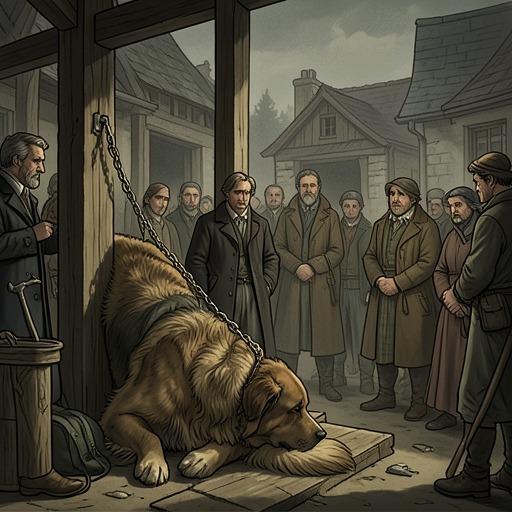
Manuel
The Call of the WildManuel is the gardener’s helper whose treachery begins Buck’s passage from the sheltered world of Judge Miller’s estate into the brutal economy of the North. Driven by gambling debt, he sells Buck for money, and although he disappears from the narrative immediately afterward, his action remains the human cause behind Buck’s abduction, forced labor, and eventual return to ancestral life.
Identity and Circumstances
Manuel works as one of the gardener’s helpers in the Santa Clara Valley household of Judge Miller. The narrative gives him little personal distinction beyond his precarious employment and his responsibilities toward a wife and numerous children. His wages do not meet those needs, while his compulsive devotion to the Chinese lottery repeatedly draws him toward financial ruin.
His decisive weakness is not merely gambling but faith in a system. Because such a system requires money, Manuel’s limited wages cannot sustain it, and the pressures of poverty, family obligation, and speculation converge in his betrayal. The account presents him as an ordinary subordinate whose economic vulnerability has consequences far beyond his own life.
The Betrayal of Buck
In the fall of 1897, the Klondike Gold Rush was drawing men toward the frozen North. Buck, then a powerful and well-treated dog living as a country aristocrat, knew nothing of the wider movement or of Manuel’s danger. On the night of the betrayal, Judge Miller was attending a meeting of the Raisin Growers’ Association while the boys of the household were organizing an athletic club. No one observed Manuel leading Buck through the orchard under the pretense of an ordinary walk.
Manuel and Buck reached College Park, a small flag station, where a solitary stranger waited. Money changed hands between the stranger and Manuel. The stranger ordered that the goods be wrapped before delivery, and Manuel doubled a stout rope around Buck’s neck beneath his collar. He then explained how the rope should be twisted to choke the dog, showing that the transaction involved deliberate preparation rather than an accidental loss of control.
Buck initially accepted the rope with quiet dignity because he trusted familiar men and assumed that human judgment exceeded his own. When the stranger took the rope’s ends, however, Buck growled in warning. He believed that this expression of displeasure should command obedience, but the rope tightened and cut off his breath. Buck attacked in sudden fury; the stranger grappled him by the throat, threw him onto his back, and maintained the choking pressure until Buck’s strength failed and his eyes glazed.
The betrayal therefore works as a violent rupture in Buck’s understanding of human relations. Manuel exploits the trust created by domestic service and familiarity, while the stranger converts Buck directly into saleable property. The scene’s central irony is that Buck is not defeated through a fair contest but handed over by someone he has learned to trust.
From Household Companion to Commodity
Buck’s sale connects Manuel’s private gambling problem to the wider commercial machinery created by the Klondike Gold Rush. The northern demand for dogs has inflated their prices, and the man in the red sweater offers Perrault three hundred dollars, with the purchase charged to government money. Perrault recognizes Buck as an exceptionally valuable animal, but the exchange nevertheless treats him as a transport asset whose worth can be measured in cash.
After the sale, Buck leaves the warm Southland from the deck of the Narwhal and is taken below with Curly. Perrault and Francois assume custody of him, beginning his movement through a chain of owners and handlers. Manuel does not accompany Buck, explain himself, or return to the story. His absence emphasizes the impersonal structure of the sale: once money has passed, the betrayed dog is carried into a new system in which ownership, labor, and survival determine his fate.
The consequences extend beyond the immediate transaction. Buck is introduced to the man in the red sweater and learns that a club establishes a law he cannot resist. He watches other dogs arrive in crates or at the ends of ropes, sees some beaten into submission, and witnesses one killed for refusing to obey. Manuel’s act has thus placed Buck at the threshold of the Law of Club and Fang, where the assumptions of civilized domestic life no longer protect him.
Narrative Consequences
Manuel’s betrayal indirectly initiates every major transformation in Buck’s recorded life. Buck becomes a Sled dog, learns the discipline of the traces, encounters Perrault and Francois, and develops skills demanded by the Yukon Trail. Under the pressures of hunger, rivalry, labor, and violence, instincts inherited from ancient Gray wolf ancestors awaken within him. The narrative explicitly links this recovery of ancestral life to the discovery of gold in the North and to the fact that Manuel’s wages could not support his family.
That causal link gives Manuel’s small act an unusually large narrative reach. A single gambling debt helps set in motion Buck’s Decivilization: the collapse of his old assumptions, the growth of cunning, the mastery of trail life, and the resurgence of the dominant primordial beast. Manuel does not intend or witness these changes, but his economic desperation becomes the opening mechanism through which they occur.
The later history of northern dogs also reveals the full system into which Buck has been sold. Government mail demands lead exhausted teams to be replaced and dogs deemed worthless to be sold because animals count for little against dollars. Buck eventually falls into the hands of Hal, Charles, and Mercedes, whose ignorance, cruelty, and mismanagement cause starvation and death among the team. John Thornton later rescues Buck from that abuse, but even the rescue occurs within the same ownership-centered world: Hal insists that Buck is his dog, while Thornton intervenes against further beating and cuts the traces.
Significance
Manuel is a minor character with a foundational function. He embodies the economic fragility beneath the Gold Rush’s grand movement: the North promises wealth, but the pressure of money also turns a trusted household worker into a seller of another living being. His gambling is personal, yet the consequences are structural, linking domestic labor, debt, animal commerce, government transport, and frontier exploitation.
His role also sharpens the contrast between price and value. Manuel receives money for Buck, while Perrault sees an animal worth hundreds of dollars and perhaps far more in working capacity. Later, Buck’s strength can inspire a wager involving one thousand dollars, and John Thornton’s party finds gold by the thousands in a remote placer. Against these monetary calculations stands Buck’s lived history: trust, pain, labor, starvation, attachment, and survival. Manuel’s betrayal begins the process by which Buck is reduced to a commodity, but the rest of the narrative traces how that commodity becomes an intelligent worker, a beloved companion to John Thornton, and finally a creature capable of answering the call of the wild.